$4.45
You have been lied to.
Not the loud kind of lie. Not the one shouted from a stage. I am talking about the quiet one. The polite one. The one that seeps into your bones like a slow-leak drought of the soul.
The lie that says humans sit at the top of the thinking ladder.
That we are the final word on intelligence. That everything beneath us just reacts.
Take it easy, they say. Birds are instinct. Birds are simple. Chill out.
No.
That is a comfortable story. And comfortable stories make soft minds.
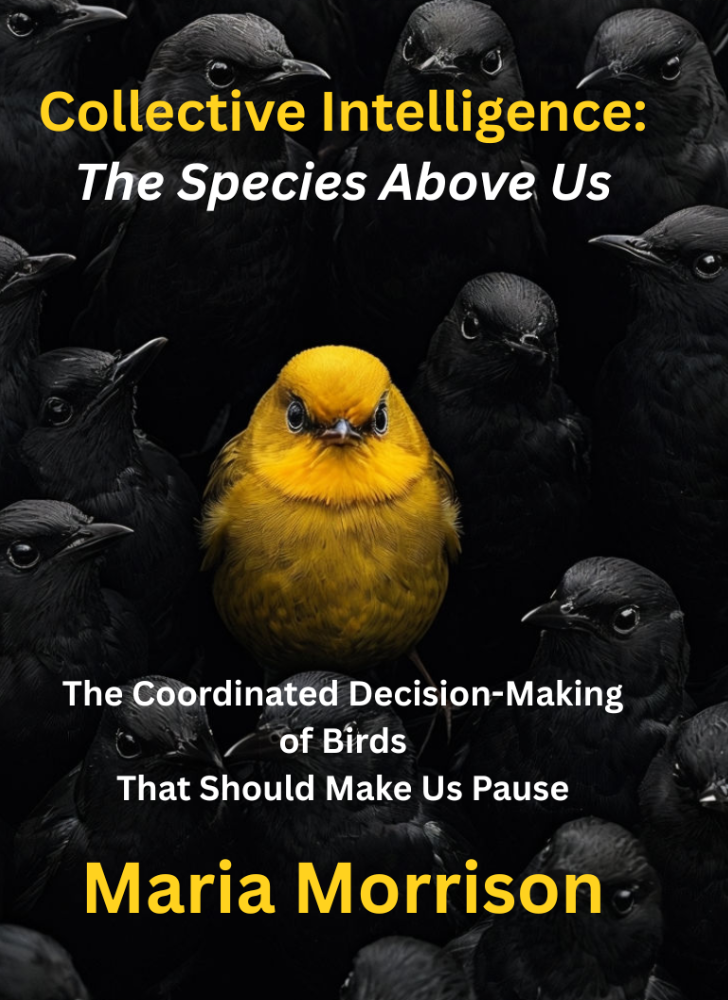
Collective Intelligence: The Species Above Us is going to ruin that comfort for you. And it should.
Because here is the dead stop moment: a flock of birds can make faster, more accurate survival decisions as a group than most corporate boards, military committees, or city councils ever will. No chairman. No vote. No speech. Just movement. Precision. Agreement.
You think that is small? It is not small. It is unsettling.
I learned that lesson the hard way one winter evening. I was sitting on the porch shelling peas, watching the tree line. The wind shifted before I felt it. The goats stirred before I heard it. And then the birds lifted. Not one. Not two. All of them. They rose like a single lung pulling breath. They turned together, tightened together, scattered together. No chaos. No panic. Just decision.
Storm hit twelve minutes later.
Those birds didn’t argue. They didn’t post about it. They moved.
And that is the crystal clear problem this book is going to solve for you: we have forgotten how to make decisions together without tearing each other apart.
You feel it. In your workplace. In your community. Around your own kitchen table. Everyone talking. Nobody listening. Noise instead of direction.
This book offers you something irresistible: a front-row seat to the hidden architecture of coordinated thought in the sky. Not poetry. Not sentiment. The real mechanisms. How birds process threat. How they distribute information without a leader barking orders. How thousands move as one without surrendering individual awareness.
That should make you pause.
The unique mechanism inside this book is simple, but it is not easy. I call it the “Shared Signal Principle.” Birds do not wait for permission. They respond to small shifts at the edge. They trust proximity. They adjust in motion. This book breaks down how that works and how you can apply the same pattern recognition and distributed awareness to your own life.
Instead of trying to control every outcome like a nervous rancher chasing chickens in the yard, you will learn to read signals earlier. You will learn to respond instead of react. You will learn when to tighten the circle and when to break formation.
From city sidewalks to quiet homestead—that is the path.
At the beginning, you are overwhelmed. Drowned in opinions. Tugged in twelve directions. Decision fatigue hanging on you like wet denim.
By the end, you will see patterns where you once saw chaos. You will understand how coordinated systems actually function. You will recognize when a group is healthy and when it is rotting from the inside. And you will carry yourself differently because you will know something most people don’t: intelligence is not loud. It is aligned.
The benefits are not abstract. You will make cleaner decisions. You will trust your instincts without becoming reckless. You will build teams that move with purpose instead of ego. You will sleep better because you will understand the rhythm of collective behavior instead of fearing it.
And maybe most importantly, you will stop underestimating the world around you.
Folks, stewardship is a chore. Thinking is a chore. Paying attention is a chore. But ignoring the systems that are clearly more coordinated than we are? That is laziness.
If you are tired of surface-level answers… if you are done pretending humans have nothing left to learn… if you are ready to look up at the sky and admit we might not be the sharpest minds in the field…
Then this book is for you.
Join the ranks of those who still care enough to pay attention. The birds have been demonstrating something extraordinary above our heads for centuries.
It is time we stop dismissing it.
And start learning from it.
We have been fooled into thinking we’re the smartest creatures in the yard. We think the sky is empty decoration. We think the birds on the wire are just background noise while we scroll our phones and complain about traffic.
Here’s the slow-leak drought of the soul: we stopped paying attention.
And when you stop paying attention, you get soft. You get sloppy. You start believing the world revolves around your schedule, your opinions, your little glowing screen. Meanwhile, right above your head, there’s coordination, strategy, memory, and decision-making happening without applause.
Collective Intelligence: The Species Above Us is not a sweet little birdwatching book. It is a hard look at the kind of awareness we’ve grown lazy about. It asks a question most folks don’t even know they’re avoiding: what if we’ve underestimated the minds sharing our space?
Take Chapter 2, The Shadow Flock: How Birds Watch and Remember Everything. You’re gonna learn that certain birds recognize human faces and hold grudges. Not for a minute. For years. Think about that the next time you assume you’re the only one keeping score.
Or Chapter 5, Feathered Saboteurs: How Birds Outsmart Humans. We build systems. They study them. Trash schedules, traffic lights, crop cycles. They adjust faster than we do. That’s not chaos. That’s observation followed by action.
Now let me tell you a porch story.
When I was a girl, my grandmother used to say, “If you want to know how to survive winter, watch the animals.” One year, we ignored the way the crows gathered early and the way the geese shifted routes. We figured we had weather reports and machines. That winter hit like a brick to the ribs. Pipes froze. Feed ran low. We were the ones scrambling.
The birds? They had already moved.
Dead stop moment: birds don’t need meetings to coordinate thousands of bodies midair. They follow simple rules and adjust in seconds. No ego. No arguing. Just response. Now ask yourself how long it takes your workplace to make one decision.
This book gives you a squeezed-lemon kind of truth. Not the fluffy “nature is beautiful” kind. The kind you can feel in your hands. It shows you the mechanics behind murmurations in Murmurations of Fear: When Flocks Turn Deadly. You’ll see how alignment without a leader creates protection. That lesson alone can change how you handle conflict in your own life.
In The Unblinking Eye: Raptors That Track You Everywhere, you’ll understand what focus really looks like. A hawk doesn’t chase every distraction. It locks in. Imagine what your life would look like if you did the same.
And yes, there’s Blood on the Beak: Birds as Silent Predators. Because pretending nature is soft doesn’t make you wise. It makes you naive. Predation is precise. Efficient. Purposeful. That chapter will teach you something about timing and restraint you won’t learn in a boardroom.
You start this book on the city sidewalks—distracted, certain, maybe a little numb. You finish it standing on a quiet homestead in your own mind. More aware. More observant. Less arrogant about your place in the food chain of ideas.
You’ll sleep better because you’ll understand systems instead of fearing them. You’ll walk outside and notice patterns instead of noise. Your neighbors will look at you differently because you’ll speak with clarity about coordination, adaptation, and shared space. Not in a preachy way. In a grounded way.
Chapter 12, The Feathered Thieves, shows you how resourcefulness can look like mischief if you don’t understand it. That alone might change how you judge the scrappy people in your own life.
Chapter 14, The Apocalypse Flock — When Birds Take Over, isn’t about horror. It’s about what happens when we underestimate collective force. It’s a warning about complacency. About assuming numbers don’t matter until they do.
This isn’t about turning you into a bird expert. It’s about sharpening your awareness. It’s about humility. It’s about realizing intelligence doesn’t always wear a suit.
You’ll learn how coordinated decision-making works without central control. You’ll see how small signals ripple outward. You’ll understand how adaptability beats stubborn pride every time. And once you see it in the sky, you’ll start seeing it in your marriage, your work, your community.
That’s the benefit. Not trivia. Transformation.
If you’re tired of the kaleidoscope of distractions… if you’re tired of pretending we have nothing left to learn from the old ways… if you want your thinking to feel solid as cedar and steady as stone… then this book is your chore.
And chores build strength.
You can take it easy and keep believing the sky is empty.
Or you can look up, pay attention, and join the ranks of folks who still care about awareness, responsibility, and the quiet power of coordination.
The species above us isn’t waiting for your permission.
The only question is whether you’re gonna learn from it.
Maria Morrison is an author who believes that the right words at the right time can shift how we think, feel, and move forward. Her writing is clear, encouraging, and easy to follow created for readers who want meaningful ideas without heavy, complicated language. Each eBook is designed to be something you can return to again and again, whether you’re looking for a moment of calm, a new perspective, or a fresh way to see everyday life.
On MariaMorrisonBooks.com, her titles are organized into three simple categories to help you find what fits your mood and goals. ‘Deep Thoughts’ focuses on reflection, mindset, and the bigger questions we all think about. ‘In Addition To….’ shares extra insights and practical ideas that support daily life and personal development. ‘Unique Topics’ explores interesting subjects that don’t always fit into the usual boxes, perfect for curious readers who enjoy discovering something different. Each book is designed to inspire thought and reflection, truly “books that make you think about, What you’ve never thought about.”
Maria’s goal is to make your reading experience smooth from start to finish: choose a book, check out easily, and enjoy instant digital access. Whether you’re starting with one title or exploring a full category, you’ll find uplifting reads made to inspire, inform, and encourage your next step.
Questions, feedback, or support Maria will get back to you soon.