$4.45
What if the worst thing that ever happened to you was a meeting you booked yourself?
Stop chasing the idea that you are broken. You are not a mistake waiting to be fixed by ten easy steps. You are simply on assignment. I’m Maria Morrison, and I write the books that make you think about what you’ve never thought about. For years, you’ve felt that low-grade anxiety thrumming in your chest, that deep, unsettling feeling that something vital is missing. You’ve called it depression, or self-sabotage, or bad luck. I call it the Debt of the Void—the echo of a cosmic promise you made when you were pure data, before you had a name. The missing piece isn’t happiness; it’s a critical fragment of information you forgot you came here to collect.
You’re tired of the clichés. You’re tired of self-help that asks you to “manifest” while your life keeps repeating the same painful scenes. Why do you keep chasing the same toxic partner, the same dead-end job, the same financial wall? That’s not a flaw in your personality. That is the Geometry of Obsession (Chapter 2), and your brilliant consciousness is trying to resolve a repeating mathematical problem written into your itinerary. You didn’t arrange your worst habits by accident; you may have arranged them in advance, simply because they offered the fastest path toward a necessary lesson. That is a hard, raw truth, and it’s the only path to real power.
What if your deepest, most scarring betrayal—the one that forced your heart to expand or shatter—wasn’t random cruelty? What if the person who inflicted that wound was actually the Keeper of the Key (Chapter 5), a specialized contract player whose sole job was to deliver the necessary pain that triggers your transformation? This is the kind of emotional X-ray vision that changes everything. It flips the script from ‘victim’ to ‘master planner.’ And yes, we look at the love, too. What if the deepest connection you’ve ever known was just two pieces of cosmic code trying to correct an ancient bug? This book gives you the Sensory Recognition to know the difference.
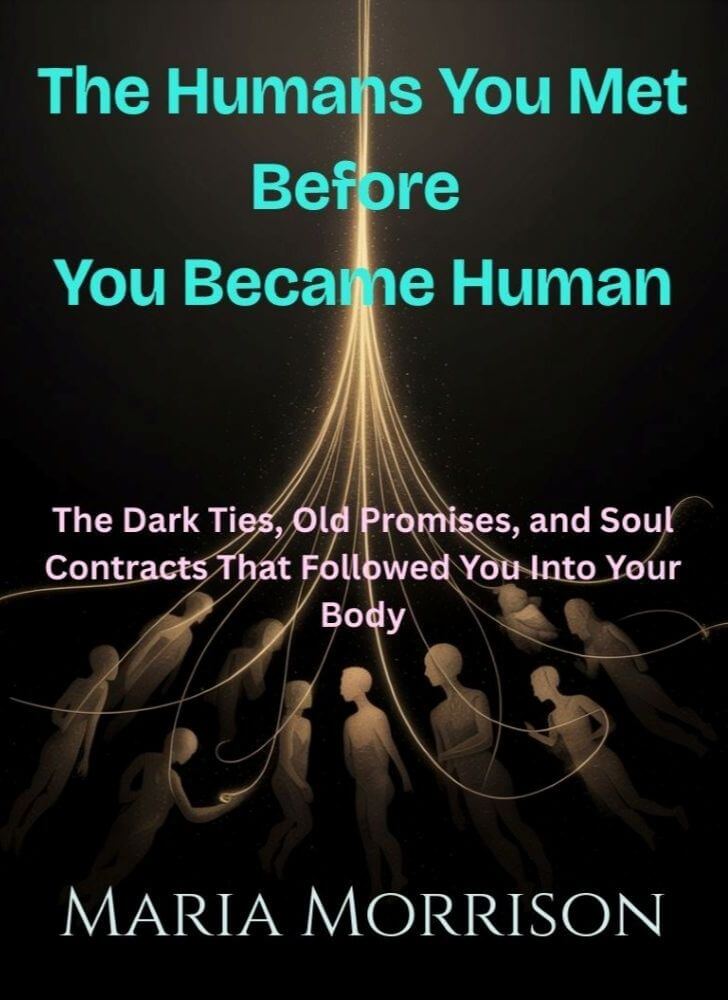
This isn’t about past lives in ancient Egypt. This is about The Humans You Met Before You Became Human—the intense, pre-written agreements you sealed with these souls so you could learn, collect, and evolve. It’s about why you have that magnetic pull toward people you’ve never spoken to, why advertisements make you feel incomplete, and why your nostalgia aches for the soundless void of energy you left behind.
The greatest news? The contract is not binding. It is an outline. This book offers you the dangerous empowerment of Renegotiating the Contract (Chapter 13). We teach you how to use your human free will to consciously rewrite your destiny. But you need to know what you’re doing. If your deepest trauma was a planned lesson, what happens to the person who delivered the pain if you refuse to accept the teaching? What happens when you use The Clarity of Abandonment and shred the debt?
This book is a mirror, a nudge, and a wake-up call, all at once. It’s for thinkers, tinkerers, and the quietly curious who are done with the fluff. You are not broken, friend. You are becoming. But you have to choose: Did you choose a life of simple happiness, or did you choose the complex, necessary path of Interest?
If you feel that profound, quiet Yes in your gut—if you are tired of waiting for permission to change—then the agreement has activated. The Humans You Met Before You Became Human is your catalyst. It is the book you didn’t know you needed until right now.
I’ve held up the mirror. I’ve dropped the conversation bomb. Now, the choice is yours. Are you ready to collect the data you came here for?
You don’t have free will. Not really.
Let’s just gut-punch that idea right here. You think you chose your partner, your job, or even the weird, low-grade panic you feel every time you open your eyes? Cute. You were just following a script. A cosmic itinerary you signed when you were nothing but pure, undifferentiated data. A flash drive in the void.
And now you’re stuck here, in this meat suit, trying to make sense of the psychic baggage that followed you through the birth canal.
You’ve read all the self-help books. You’ve journaled, you’ve meditated, you’ve cleaned the clutter (a necessary, small step, by the way—always clear the decks!). You’re still running into the same wall, chasing the same impossible people, and wondering why that deep anxiety in your gut never leaves.
I’m here to tell you: It’s not yours.
It’s not mental illness. It’s not trauma. It’s a debt of the void.
What if the low-grade panic you feel every morning is just the echo of a promise you made in a space where there was no breath to break it?
Think about that. You were pure energy. You didn’t have a voice. You only had intent. And you made an agreement—a contract—with certain other pieces of energy. They agreed to be the villains. You agreed to be the victim. They agreed to be the key to your ultimate transformation.
You think that’s dark? Good. We’re finally being honest.
Stop Running the Old Code.
We all have that thing. That repetitive behavior—booze, bad partners, self-sabotage, constantly picking a fight with the one person who loves you. You call it a “pattern.” I call it the Geometry of Obsession.
Your consciousness, that tiny spark of pure data that you are, is trying to solve a specific, repeating problem from the cosmos. You keep running into the same kind of boss, the same kind of selfish lover, the same kind of false friend, because your brain is trying to recognize a geometric pattern from your pre-human cluster.
It’s like your soul is trying to match a weird, cosmic shape. And you think you’re choosing it based on who sends you the cutest emoji.
I remember when I was deep in my own recovery work—the kind of messy, gut-wrenching work you do when you realize you can barely lead yourself out of bed, let alone be a functional human. I kept dating the same flavor of charismatic liar. Over and over. Why? Because that charismatic liar was a placeholder, a temporary stand-in for a much deeper betrayal I had agreed to experience.
Did you arrange your worst habits in advance, simply because they offered the fastest path toward a necessary piece of information?
It’s not an accident. It’s an arrangement. You needed that specific brand of pain to force your consciousness to expand. So you picked the perfect person to deliver it. You chose your ultimate betrayer.
The Taste of Their Light.
How do you recognize these pre-human colleagues? They don’t wear a name tag. They don’t have a glow.
But you feel them.
It’s that distinct electrical zing when someone walks into a room—not love, not lust, but a sudden, undeniable frequency signature. It’s the overwhelming wrongness of a situation that makes the hair stand up on your arms. It’s the smell of a memory that doesn’t belong to you. These are your non-physical senses kicking in. They are pure data streams from the old contracts.
If you have a hatred for a certain texture, a sound, or a color? Maybe it’s not an aesthetic choice.
Is the reason you despise certain sounds or textures because they clash with the unique frequency signature of your original cluster?
And déjà vu? That feeling that you’ve been here before? Stop comforting yourself with the lie of “past human lives.” That’s a soft answer for a chilling truth. That flash of familiarity? It’s not recognition of a place. It’s recognition of intent. It’s the moment your consciousness aligns with the pre-human data of another being, and the agreement is about to be activated.
You are about to run the code.
If déjà vu is only a signal that an agreement is about to be activated, what happens when you decide to break the contract right when they walk in the room?
Lovers, Liars, and Data Bugs.
Let’s talk about the relationships that break you open. The intense, magnetic, can’t-breathe fusion with a lover. You call it destiny. I call it existential verification.
That intense connection isn’t “love” in the fluffy human sense. It’s two original information packets temporarily merging. You are checking the integrity of your shared data. You are comparing notes on the cosmos. It’s not about romance; it’s about making sure your code is still clean.
What if the deepest love you’ve ever known was just two pieces of cosmic code trying to correct an ancient bug?
And what about the ones who just watch you burn? The single friend who never gives advice. The silent family member who just observes your crisis. We think they’re passive. We think they’re useless. Wrong.
Their pre-human role was the Witness Contract. They agreed to be the constant, unchanging data sink needed to record your human experience. They are the still point the contract requires.
Is the quietest person in your life the most important, because they are the only one fulfilling the agreement to simply observe?
And the heartbreaks that leave you hollow—the person you saw on the street, the connection you almost made? That’s an agreement that failed to activate. A lesson that was scheduled but was derailed by human free will. It leaves an unbearable weight of the unmet.
Who did you pass on the street today whose contract you desperately needed to complete, and now you’ll both have to wait another lifetime?
The Siren Song of the Mass.
You’re not just carrying your own baggage; you’re swimming in a collective pool of pre-human data structures.
Why do we all suddenly obsess over the same celebrity? Why do fleeting political movements ignite so quickly? That’s not just social media. That’s the Consensus Myth in action. It’s a temporary mass alignment event where enough people with a similar data structure temporarily merge their consciousness.
You think you’re cheering for a sports team because of loyalty? No. You’re craving the feeling of being pure, synchronized data again—the feeling of the original, undifferentiated cluster. The ecstatic roar of the crowd is pure, terrifying data transfer.
Does the ecstatic roar of a crowd hide the terrifying fact that you have just temporarily sacrificed your individual consciousness to the mass?
And that deep, melancholic pull of nostalgia? It’s not longing for your old bedroom. It’s your consciousness trying to recall the feeling of being pure energy before the terrible, beautiful weight of a human body was assigned to it.
Is the deepest sadness you’ve ever felt the memory of the moment you agreed to leave the soundless void and be born into noise?
The marketing wizards know this. They tap into that primal anxiety/debt from Chapter 1. They promise to fill the gap using the language of your original cosmic arrangement. They sell you products that promise wholeness because they are selling you your own shadow.
When an advertisement makes you feel incomplete, is it selling a product, or reminding you of the information you agreed to lose?
Renegotiate Your Contract.
Listen. This book isn’t about helplessness. It’s about radical agency. The contract isn’t binding; it’s an outline. Human free will is the ultimate wildcard.
This is your Clarity of Abandonment chapter. You get to shred the debt. You get to walk away. But that’s terrifying, isn’t it?
Is the reason you can’t walk away from them because you know your own consciousness might splinter if their light leaves the frame?
The key to all of this—to your ultimate empowerment—is the Conscious Collection of the missing data. The lesson. The key. It involves brutal self-honesty. You have to admit you signed the entire itinerary before you had a name.
The Humans You Met Before You Became Human is a dangerous read. It’s your emotional X-ray vision into the deepest agreements you made. It will force you to ask the final, terrifying question:
Did you choose to make your life interesting (full of drama, necessary pain, and growth) or happy (simple, safe, and easily resolved)?
When you return to the void, will you be judged on your peace, or on the complexity of the data you brought back?
It’s time to stop thinking like a victim. It’s time to think like a conscious architect of your own necessary trauma.
ThConsciousness Geometry
e script is on the table. Are you ready to rewrite your ending?
Category 1: Psychological/Behavioral (The Internal Shock)
These chapters explore how pre-human agreements manifest as psychological urges, anxieties, and patterns we cannot control.
Chapter 1. The Debt of the Void: Why Your Anxiety Isn’t Yours
Directional Topic: Exploring anxiety, depression, and self-sabotage not as mental illness, but as a psychic ‘debt’ or ‘memory’ of an unfulfilled cosmic agreement made when you were pure data. The feeling that something is missing is not a human lack, but a gap in the original energetic cluster.
Conversation Bomb: What if the low-grade panic you feel every morning is just the echo of a promise you made in a space where there was no breath to break it?
Chapter 2. The Geometry of Obsession: Why You Keep Chasing the Same Wall
Directional Topic: Analyzing repetitive negative behaviors and “types” of people you are drawn to (lovers, bosses, false friends). These are not accidents, but attempts to resolve a specific, repeating geometric problem in your consciousness matrix. Your brain is trying to recognize a pattern from the cosmos.
Conversation Bomb: Did you arrange your worst habits in advance, simply because they offered the fastest path toward a necessary piece of information?
Chapter 3. Sensory Recognition: The Taste of Their Light
Directional Topic: How do we recognize our pre-human colleagues? This chapter explores the “non-physical senses”: that distinct electrical feel in a room, the smell of a memory, the sudden, overwhelming wrongness of a situation, and how these signals are actually pure data streams from the agreements.
Conversation Bomb: Is the reason you despise certain sounds or textures because they clash with the unique frequency signature of your original cluster?
Chapter 4. The False Comfort of Déjà Vu: We Were Never Here Before
Directional Topic: Deconstructing the comforting myth of “past human lives” and replacing it with the chilling reality that the familiar feeling is the moment your consciousness aligns with the pre-human data of another being. It’s not recognition of a place, but recognition of intent.
Conversation Bomb: If déjà vu is only a signal that an agreement is about to be activated, what happens when you decide to break the contract right when they walk in the room?
Category 2: Interpersonal/Relational (The Dangerous Connection)
These chapters focus on specific, high-stakes relationships—love, conflict, family—and how they are merely fulfilling pre-written roles.
Chapter 5. The Keeper of the Key: Choosing Your Ultimate Betrayer
Directional Topic: The concept that your deepest, most painful betrayal was pre-planned. The betrayer is not a villain, but the keeper of the key to your transformation. Their role was to inflict a specific, profound wound that forces your consciousness to expand.
Conversation Bomb: Did you choose the person who would abandon you the moment before you entered the human realm, sealing the contract with a promise of necessary pain?
Chapter 6. Lovers as Mirrors: The Agreement of Fusion
Directional Topic: Examining intensely intimate relationships. The connection isn’t love in the human sense, but a temporary fusion of the two original information packets, allowing both to check the integrity of their shared data. It’s not about romance; it’s about existential verification.
Conversation Bomb: What if the deepest love you’ve ever known was just two pieces of cosmic code trying to correct an ancient bug?
Chapter 7. The Witness Contract: The Ones Who Just Watch You Burn
Directional Topic: Exploring the seemingly random people in your life—that single friend who never gives advice, the bystander during a crisis, the silent family member. Their pre-human role was simply to be the constant, unchanging data sink needed to record your human experience.
Conversation Bomb: Is the quietest person in your life the most important, because they are the only one fulfilling the agreement to simply observe?
Chapter 8. The Unbearable Weight of the Unmet: When Agreements Fail to Activate
Directional Topic: Discussing the strange, magnetic pull toward people you never speak to (the face in the crowd, the person across the room). This is an agreement that failed to activate in this lifetime—a necessary lesson that was scheduled but was derailed by human free will, leaving a hollow ache.
Conversation Bomb: Who did you pass on the street today whose contract you desperately needed to complete, and now you’ll both have to wait another lifetime?
Category 3: Societal/Cultural (The Collective Unease)
These chapters look outward, exploring how these pre-human dynamics subtly influence mass behavior, group conflicts, and modern media narratives.
Chapter 9. The Consensus Myth: Why We All Agree on the Wrong Things
Directional Topic: How groupthink, cultural obsessions, and media trends are not simply social; they are temporary mass alignment events where enough people with a similar pre-human data structure temporarily merge their consciousness (e.g., fleeting political movements or celebrity worship).
Conversation Bomb: What if a global tragedy is simply a required, high-volume download of information for the entire human consciousness cluster?
Chapter 10. The Illusion of Tribe: Why Your Team Feels Like Family
Directional Topic: Examining the pull of sports teams, fandoms, or political affiliations. This isn’t loyalty; it’s the momentary, safe re-creation of the original, undifferentiated cluster consciousness. It’s a craving for the feeling of being pure, synchronized data again.
Conversation Bomb: Does the ecstatic roar of a crowd hide the terrifying fact that you have just temporarily sacrificed your individual consciousness to the mass?
Chapter 11. The Modern Exploitation: Selling You Your Own Shadow
Directional Topic: This chapter explores how marketing, advertising, and social media algorithms tap directly into the primal, pre-human agreements and unmet needs. They promise the resolution of the anxiety/debt (Chapter 1) using the language of your original cosmic arrangement.
Conversation Bomb: When an advertisement makes you feel incomplete, is it selling a product, or reminding you of the information you agreed to lose?
Chapter 12. The Siren Song of Nostalgia: Longing for What Never Was
Directional Topic: Analyzing the deep, melancholic pull of nostalgia. It is not the longing for childhood or a specific past decade, but the consciousness trying to recall the feeling of being pure energy before the terrible, beautiful weight of a human body was assigned to it.
Conversation Bomb: Is the deepest sadness you’ve ever felt the memory of the moment you agreed to leave the soundless void and be born into noise?
Category 4: Self-Help/Transformational (The Dangerous Empowerment)
These chapters leverage the concept to promote radical agency, choice, and conscious intervention into the pre-planned script.
Chapter 13. Renegotiating the Contract: Changing Your Script Mid-Life
Directional Topic: Offering a pathway to conscious intervention. The “contract” is not binding but an outline. We explore how to use human free will to consciously rewrite the agreement, thereby changing your relationships, financial destiny, and psychological patterns.
Conversation Bomb: If your deepest trauma was a planned lesson, what happens to the person who delivered the pain if you refuse to accept the teaching?
Chapter 14. The Clarity of Abandonment: When to Shred the Debt
Directional Topic: The power of radical severance. This chapter provides the psychological tools for consciously abandoning a long-term agreement that is no longer serving its purpose, even if it feels terrifying. It’s about shredding the old data and forcing a new, better geometry.
Conversation Bomb: Is the reason you can’t walk away from them because you know your own consciousness might splinter if their light leaves the frame?
Chapter 15. Conscious Collection: Finding the Missing Piece of Data
Directional Topic: Focus on practical steps for finding and integrating the missing information (the “lesson” or “key”) you agreed to collect. This involves radical self-honesty and a willingness to embrace the psychological danger that comes with completion.
Conversation Bomb: Does empowerment mean taking back control of your life, or finally admitting you signed the entire itinerary before you had a name?
Chapter 16. The Final Choice: The Geometry of Interest vs. Happiness
Directional Topic: The concluding chapter returns to the ultimate question: did you choose to make your human life interesting (full of drama, growth, and necessary pain) or happy (simple, safe, and easily resolved)? This is the moment of final, conscious agency.
Conversation Bomb: When you return to the void, will you be judged on your peace, or on the complexity of the data you brought back?
Maria Morrison is an author who believes that the right words at the right time can shift how we think, feel, and move forward. Her writing is clear, encouraging, and easy to follow created for readers who want meaningful ideas without heavy, complicated language. Each eBook is designed to be something you can return to again and again, whether you’re looking for a moment of calm, a new perspective, or a fresh way to see everyday life.
On MariaMorrisonBooks.com, her titles are organized into three simple categories to help you find what fits your mood and goals. ‘Deep Thoughts’ focuses on reflection, mindset, and the bigger questions we all think about. ‘In Addition To….’ shares extra insights and practical ideas that support daily life and personal development. ‘Unique Topics’ explores interesting subjects that don’t always fit into the usual boxes, perfect for curious readers who enjoy discovering something different. Each book is designed to inspire thought and reflection, truly “books that make you think about, What you’ve never thought about.”
Maria’s goal is to make your reading experience smooth from start to finish: choose a book, check out easily, and enjoy instant digital access. Whether you’re starting with one title or exploring a full category, you’ll find uplifting reads made to inspire, inform, and encourage your next step.
Questions, feedback, or support Maria will get back to you soon.